Private Equity

Leapfrogging the IPO gridlock: Chinese companies get a taste for reverse takeovers — Reuters

Reuters

Leapfrogging the IPO gridlock: Chinese companies get a taste for reverse takeovers

How Renminbi funds took over Chinese private equity (Part 2) — SuperReturn Commentary

Superretrun logo

How Renminbi funds took over Chinese private equity

(Part 2)

 
Large and small ships traverse the Huangpu River 24 hours a day, 7 days a week, and 365 days a year.

Part two of a series. Read part one.

Gresham’s Law, as many of us were taught a while back, stipulates that bad money drives out good. There’s something analogous at work in China’s private equity and venture capital industry. Only here it’s not a debased currency that’s dominating transactions. Instead, it’s Renminbi private equity (PE) firms. Flush with cash and often insensitive to valuation and without any clear imperative to make money for their investors, they are changing the PE industry in China beyond recognition and making life miserable for many dollar-based PE and venture capital (VC) firms.

Outbid, outspent and outhustled

From a tiny speck on the PE horizon five years ago, Reminbi (RMB) funds have quickly grown into a hulking presence in China. In many ways, they now run the show, eclipsing global dollar funds in every meaningful category – number of active funds, deals closed and capital raised. RMB funds have proliferated irrespective of the fact there have so far been few successful exits with cash distributions.

The RMB fund industry works by a logic all its own. Valuations are often double, triple or even higher than those offered by dollar funds. Term sheets come in faster, with fewer of the investor preferences dollar funds insist on. Due diligence can often seem perfunctory.  Post-deal monitoring? Often lax, by global standards. From the perspective of many Chinese company owners, dollar PE firms look stingy, slow and troublesome.

The RMB fund industry’s greatest success so far was not the IPO of a portfolio company, but of one of the larger RMB general partners, Jiuding Capital. It listed its shares in 2015 on a largely-unregulated over-the-counter market called The New Third Board. For a time earlier this year, Jiuding had a market cap on par with Blackstone, although its assets under management, profits, and successful deal record are a fraction of the American firm’s.

The main investment thesis of RMB funds has shifted in recent years. Originally, it was to invest in traditional manufacturing companies just ahead of their China IPO. The emphasis has now shifted towards investing in earlier-stage Chinese technology companies. This is in line with China’s central government policy to foster more domestic innovation as a way to sustain long-term GDP growth.

The Shanghai government, which through different agencies and localities has become a major sponsor of new funds, has recently announced a policy to rebate a percentage of failed investments made by RMB funds in Shanghai-based tech companies. Moral hazard isn’t, evidently, as high on their list of priorities as taking some of the risk out of risk-capital investing in start-ups.

Dollar funds, in the main, have mainly been observing all this with sullen expressions. Making matters worse, they are often sitting on portfolios of unexited deals dating back five years or more. The US and Hong Kong stock markets have mainly lost their taste for PE-backed Chinese companies. While RMB funds seem to draw from a bottomless well of available capital, for most dollar funds, raising new money for China investing has never been more difficult.

RMB funds seldom explain themselves, seldom appear at industry forums like SuperReturn. One reason: few of the senior people speak English. Another: they have no interest or need to raise money from global limited partners. They have no real pretensions to expand outside China. They are adapted only and perhaps ideally to their native environment. Dollar funds have come to look a bit like dinosaurs after the asteroid strike.

Can dollar-denominated firms strike back?

Can dollar funds find a way to regain their central role in Chinese alternative investing? It won’t be easy. Start with the fact the dollar funds are all generally the slow movers in a big pack chasing the same sort of deals as their RMB brethren. At the moment, that means companies engaged in online shopping, games, healthcare and mobile services.

A wiser and differentiated approach would probably be to look for opportunities elsewhere. There are plenty of possibilities, not only in traditional manufacturing industry, but in control deals and roll-ups. So far, with few exceptions, there’s little sign of differentiation taking place. Read the fund-raising pitch for dollar and RMB funds and, apart from the difference in language, the two are eerily similar. They sport the same statistics on internet, mobile, online shopping penetration: the same plan to pluck future winners from a crop of look-alike money-losing start-ups.

There is one investment thesis the dollar PE funds have pretty much all to themselves. It’s so-called “delist-relist” deals, where US-quoted Chinese companies are acquired by a PE fund together with the company’s own management, delisted from the US market with the plan to one day IPO on China’s domestic stock exchange. There have been a few successes, such as the relisting last year of Focus Media, a deal partly financed by Carlyle. But, there are at least another forty such deals with over $20bn in equity and debt sunk into them waiting for their chance to relist. These plans suffered a rather sizeable setback recently when the Chinese central government abruptly shelved plans to open a new “strategic stock market” that was meant to be specially suited to these returnee companies. The choice is now between prolonged limbo, or buying a Chinese-listed shell to reverse into, a highly expensive endeavor that sucks out a lot of the profit PE firms hoped to make.

Outspent, outbid and outhustled by the RMB funds, dollar PE funds are on the defensive, struggling just to stay relevant in a market they once dominated. Some are trying to go with the flow and raise RMB funds of their own. Most others are simply waiting and hoping for RMB funds to implode.

So much has lately gone so wrong for many dollar PE and VC in China. Complicating things still further, China’s economy has turned sour of late. But, there’s still a game worth playing. Globally, most institutional investors are under-allocated to China.  A new approach and some new strategies at dollar funds are overdue.

Peter Fuhrman moderates our SuperReturn China 2016 Big Debate: ‘How Do You Best Manage Your Exposure To China?’. Discussants include:

  • John Lin, Managing Partner, NDE Capital (GP)
  • Xisheng Zhang, Founding Partner & President, Hua Capital (GP)
  • Bo Liu, Chief Investment Officer, Wanda Investment (LP)
The Big Debate takes place on Tuesday 19 April 2016 at 11:55 – 12:25 at SuperReturn China in Beijing. Can’t make it? Follow the action on Twitter.

Outbid, outspent and outhustled: How Renminbi funds took over Chinese private equity (Part 1) — SuperReturn Commentary

Superretrun logo

SR

Outbid, outspent and outhustled

Renminbi-denominated private equity funds basically didn’t exist until about five years ago. Up until that point, for ten golden years, China’s PE and VC industry was the exclusive province of a hundred or so dollar-based funds: a mix of global heavyweights like Blackstone, KKR, Carlyle and Sequoia, together with pan-Asian firms based in Hong Kong and Singapore and some “China only” dollar general partners like CDH, New Horizon and CITIC Capital. These firms all raised money from much the same group of larger global limited partners (LPs), with a similar sales pitch, to make minority pre-IPO investments in high-growth Chinese private sector companies then take them public in New York or Hong Kong.

All played by pretty much the same set of rules used by PE firms in the US and Europe: valuations would be set at a reasonable price-to-earnings multiple, often single digits, with the usual toolkit of downside protections. Due diligence was to be done according to accepted professional standards, usually by retaining the same Big Four accounting firms and consulting shops doing the same well-paid helper work they perform for PE firms working in the US and Europe. Deals got underwritten to a minimum IRR of about 25%, with an expected hold period of anything up to ten years.

There were some home-run deals done during this time, including investments in companies that grew into some of China’s largest and most profitable: now-familiar names like Baidu, Alibaba, Pingan, Tencent. It was a very good time to be in the China PE and VC game – perhaps a little too good. Chinese government and financial institutions began taking notice of all the money being made in China by these offshore dollar-investing entities. They decided to get in on the action. Rather than relying on raising dollars from LPs outside China, the domestic PE and VC firms chose to raise money in Renminbi (RMB) from investors, often with government connections, in China. Off the bat, this gave these new Renminbi funds one huge advantage. Unlike the dollar funds, the RMB upstarts didn’t need to go through the laborious process of getting official Chinese government approval to convert currency. This meant they could close deals far more quickly.

Stock market liberalization and the birth of a strategy

Helpfully, too, the domestic Chinese stock market was liberalized to allow more private sector companies to go public. Even after last year’s stock market tumble, IPO valuations of 70X previous year’s net income are not unheard of. Yes, RMB firms generally had to wait out a three-year mandated lock-up after IPO. But, the mark-to-market profits from their deals made the earlier gains of the dollar PE and VC firms look like chump change. RMB funds were off to the races.

Almost overnight, China developed a huge, deep pool of institutional money these new RMB funds could tap. The distinction between LP and GP is often blurry. Many of the RMB funds are affiliates of the organizations they raise capital from. Chinese government departments at all levels – local, provincial and national – now play a particularly active role, both committing money and establishing PE and VC funds under their general control.

For these government-backed PE firms, earning money from investing is, at best, only part of their purpose. They are also meant to support the growth of private sector companies by filling a serious financing gap. Bank lending in China is reserved, overwhelmingly, for state-owned companies.

A global LP has fiduciary commitments to honor, and needs to earn a risk-adjusted return. A Chinese government LP, on the other hand, often has no such demand placed on it. PE investing is generally an end-unto-itself, yet another government-funded way to nurture China’s economic development, like building airports and train lines.

Chinese publicly-traded companies also soon got in the act, establishing and funding VC and PE firms of their own using balance sheet cash. They can use these nominally-independent funds to finance M&A deals that would otherwise be either impossible or extremely time-consuming for the listed company to do itself. A Chinese publicly-traded company needs regulatory approval, in most cases, to acquire a company. An RMB fund does not.

The fund buys the company on behalf of the listed company, holding it while the regulatory approvals are sought, including permission to sell new shares to raise cash. When all that’s completed, the fund sells the acquired company at a nice mark-up to its listed company cousin. The listco is happy to pay, since valuations rise like clockwork when M&A deals are announced. It’s called “market cap management” in Chinese. If you’re wondering how the fund and the listco resolve the obvious conflicts of interest, you are raising a question that doesn’t seem to come up often, if at all.

Peter continues his discussion of the growth of Renminbi funds next week. Stay tuned! He also moderates our SuperReturn China 2016 Big Debate: ‘How Do You Best Manage Your Exposure To China?’.

http://www.superreturnlive.com/

New Year gambling hints at Chinese entrepreneurial vigour — The Financial Times

FT logo


FT beyondbrics

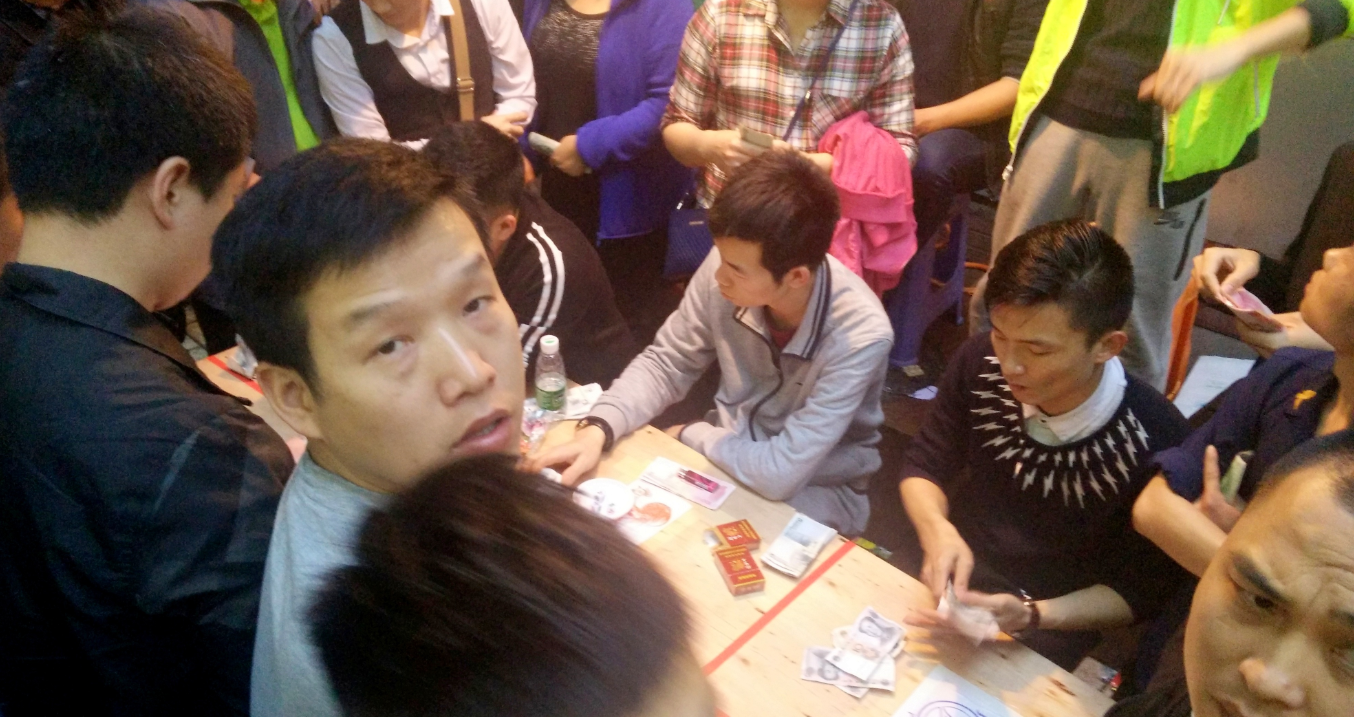
With about every major leading economic indicator in a tailspin, it’s easy, even obvious, to be bearish about China. But, one sign of economic activity could hardly seem more robust: the crowds and cash at gambling tables during this year’s Chinese New Year.

The two-week long lunar New Year celebration finally drew to a close on Monday with the Lantern Festival. Here in Shenzhen, China’s richest city per capita, no sooner do the shops all shut down for the long break than the gambling tables spill out onto the street, like the cork flying out of a bottle.

Gambling, especially in public places with large sums being wagered, is illegal everywhere in China. All the same, the New Year is ready-made for gamblers and street-corner croupiers to gather. For one thing, most police and urban street patrols are also away from their jobs with family.

Along with over-eating and giving cash-stuffed red envelopes, gambling is the other main popular indulgence during the New Year. Most of it happens behind closed doors with families gathered around the mahjong and card table. But parts of Shenzhen soon take on the appearance of an al fresco Macau (see photo).


This year, from what I could see, the number of punters and sums being wagered was far higher than years past. This matters not only as a statement of consumer optimism here but also as affirmation of the love of risk-taking that helps make China such a hotbed of entrepreneurial activity.

The two forces operating together – not only at street corner casinos — are perhaps the best reason to be optimistic that China’s economy may yet avoid a “hard landing” and continue to thrive.

In my neighborhood, the favorite game on the street is a form of craps where people bet on which of six auspicious animals and lucky symbols will turn up. Hundreds of renminbi change hands with each roll. No small bets allowed. The gambling goes on from morning until late at night.

It’s a game that requires no skill and one that also gives the house a huge advantage, since winning bets only make four times the sum wagered. This puts it in a somewhat similar league with punto banco baccarat, the casino game Chinese seem to like the most. It’s also game of pure chance, where the house has a built-in edge.

In China, gamblers’ capital flows to games with unfair odds, where dumb luck counts for more than smarts. In this there is cogent parallel with the investment culture in China. China is simply awash in risk-loving risk capital.

Street-side gambling is popular during the New Year break in part because the other more organised mainstream forms of taking a punt are shut down. Top of the list, of course, is the Chinese domestic stock market. It’s rightly called the world’s largest gambling den. Shares bob up and down in unison, prices decoupled from underlying economic factors, a company’s own prospects or comparable valuations elsewhere.

The simple reason is that almost all shares are owned by individual traders. Fed on rumors and goaded by state-owned brokerage houses, they seem to give no more thought to which shares to buy than my neighbors do before betting Rmb200 on which dice will land on the lucky crab.

The housing market, too, traces a similar erratic arc, driven far more by short-term speculation than the need to put a roof over one’s head. Billions pour in, bidding up local housing prices in many Chinese cities to a per-square-foot level higher than just about anywhere in the West except London, Paris, New York and San Francisco. Eventually prices do begin to moderate or even fall, as happened in most smaller cities this past twelve months.

The other big pool of risk capital in China goes into direct investment in entrepreneurial ventures of all sizes and calibers. Nowhere in the world is it easier to raise money to start or grow a business than China. In part, because Chinese have a marked preference for being their own boss, so the number of new companies started each year is high. The other big factor, call it the demand side, is that there is both a lot of money available and a great enthusiasm for investing in the new, the untried, the risky.

Before coming here, I used to work in the venture capital industry in California. VCs there are occasionally accused of turning a blind eye toward risk. Compared to venture investing in China, however, even the most starry-eyed venture investor in Silicon Valley looks like a Swiss money manager.

Just about any idea here seems to attract funding, a lot of it institutional. China now almost certainly has more venture firms than the rest of the world combined. No one can keep proper count. Along with all the big global names like Sequoia and Kleiner Perkins, there are thousands of other China-only venture firms operating, along with at least as many angel groups. In addition, just about every Chinese town, city and province, along with most listed companies, have their own venture funds.

I marvel at the ease with which early-stage businesses get funded, the valuations they command and the less than diligent due diligence that takes sometimes place before money moves. Of course, a few of these venture-backed companies hit the jackpot.

Alibaba or Tencent are two that come to mind. But, initial public offering (IPO) exits for Chinese startups remain rare, and so taken as a whole, venture investing returns in China have proved meager. But, activity never seems to wane. Fad follows fad. From group shopping, to what’s known in China as “O2O” (offline-to-online) thousands of companies get started, funded and then often within less than 18 months, go pffft.

With the New Year celebrations winding down, the outdoor gambling tables in my neighborhood are being put away for another year. Work schedules are returning to normal. For all the headwinds China’s economy now faces, Chinese household savings are still apparently growing faster than GDP. This means Chinese will likely go on year-after-year amassing more money to invest, to gamble or to speculate.


 byline


http://blogs.ft.com/beyond-brics/2016/02/22/new-year-gambling-hints-at-chinese-entrepreneurial-vigour/

Download Financial Times article


“A lot hasn’t gone to plan”: SuperReturn Interview

Superretrun

Does [China’s] shift from a manufacturing-driven economy to a service-driven one make macroeconomic shocks like those seen this summer inevitable?

Peter Fuhrman: China has enjoyed something of a worldwide monopoly on hair-raising economic news of late: a stock market collapse followed by a klutzy bail-out, then a devaluation followed by a catastrophic explosion and finally near-hourly reports of sinking economic indicators. As someone who first set foot in China 34 years ago, my view is we’re in an unprecedented time of economic and financial uncertainty . Consumers and corporates are noticeably wobbling. For a Chinese government long used to ordering “Jump!” and the economy shouting back “How high?” this is not the China they thought they were commanding.  Everyone is looking for a bannister to grab.

And yet, China still has some powerful fundamentals working in its favour. Urbanization is a big one. It alone should add at least 3-4% to annual GDP a year for many years to come. The shift towards services and domestic growth as opposed to exports are two others. For now, these forces are strong enough to keep China propelling forward even as it tows heavy anchors like an ageing population, and a cohort of monopolistic state-owned enterprises (SOEs) that suck up too much of China’s capital and often achieve appalling results with it.

Look, the Chinese stock market had no business in the first place almost tripling from June last year to June of this. The correction was long, long overdue. It’s often overlooked that China’s domestic stock market has a pronounced negative selection bias. Heavily represented among the 3,000 listed companies are quite a number of China’s very worst companies, with the balance made up of lethargic, low-growth, often loss-making SOEs. The good companies, like Tencent or Baidu, predominantly expatriate themselves when it comes time to IPO. To my way of thinking, China’s domestic market still seems overpriced. The dead cats are, for now, still bouncing.


Given this overall picture, do you expect to see greater or fewer opportunities [in China] for alternative investments and why? 

Peter Fuhrman: The environment in China has been challenging, to say the least, for alternative investment firms not just in the last year, but for the better part of the last decade. A lot hasn’t gone to plan. China’s growth and opportunities proved alluring to both GPs and LPs. And yet too often, almost systematically, the big money has slipped between their fingers. Partly it’s because of too much competition, and with it ballooning valuations, from over 500 newly-launched domestic Chinese PE and VC firms. The fault also sits with home-grown mistakes, with errors by private equity firms in investment approach. This includes an excessive reliance on a single source of deal exit, the IPO, all but unheard-of in other major alternative investment environments.

Overall PE returns have been lacklustre in China, especially distributions, before the economy began to slip off the rails. In the current environment, challenges multiply. A certain rare set of investing skills should prove well-adapted: firms that can do control deals, including industry consolidating roll-ups. In other words, a whole different set of prey than China PE investors have up to now mainly stalked. These are not pre-IPO deals, not ones predicated on valuation arbitrage or the predilections of Chinese young online shoppers. There’s money to be made in China’s own Rust Belt, backing solid well-managed manufacturers, a la Berkshire Hathaway. There’s too much fragmentation across the industrial board. China will remain the manufacturing locus for the world, as well as for its own gigantic domestic market.

Another anomaly that needs correcting: Global alternative investing has been overwhelmingly skewed in China towards equity not debt. The ratio could be as high as 99:1. This imbalance looks even more freakish when you consider real lending rates to credit-worthy corporates in China are probably the highest anywhere in the advanced world, even a lot higher than in less developed places like India and Indonesia. Regulation is one reason why global capital hasn’t poured in in search of these fat yields. Another is the fact PE firms on the ground in China have few if any team members with the requisite background and experience to source, qualify, diligence and execute China securitized debt deals. There’s a bit of action in the China NPL and distress world. But, straight up direct collateralized lending to China’s AA-and-up corporates and municipalities remains an opportunity global capital has yet to seize. Meanwhile, China’s shadow banking sector has exploded in size, with over $2.5 trillion in credit outstanding, almost all of which is current. There’s big money being made in China’s securitized high-yield debt, just not by dollar investors.


What’s the overall story of alternative investors engaging with central planning? How would you characterise the regulatory environment?

Peter Fuhrman: China has had a state regulatory and administrative apparatus since Europeans were running around in pelts and throwing spears at one another. So, yes, there is a large regulatory system in China overseen by a powerful government that is very deeply involved in economic and financial planning and rule-making. One must tread carefully here. Rules are numerous, occasionally contradictory, oft-time opaque and liable to sudden change.

Less observed, however, and less harrowing for foreign investors is the core fact that the planning and regulatory system in China has a strong inbuilt bias towards the goal of lifting GDP growth and employment. Other governments talk this talk. But it’s actually China that walks the walk. The days of anything-goes, rip-roaring, pollute-as-you-go development are about done with. But, still the compass needle remains fixed in the direction of encouraging strong rates of growth.

The Chinese government has also gotten more and more comfortable with the fact that most of the growth is now coming from the highly-competitive, generally lightly-regulated private sector. Along with a fair degree of deregulation lately in industries like banking and transport, China also often pursues a policy of benign neglect, of letting entrepreneurs duke it out, and only imposing rules-of-the-game where it looks like a lot of innocents’ money may be lost or conned. To be sure, foreign investors in most cases cannot and should not operate in these more free-form areas of China’s economy. They often seem to be the first as well as the fattest targets when the clamps come down. Just ask some larger Western pharmaceutical companies about this.


In the long view, how long can the parallel USD-RMB system run? Do you expect to see the experiments in Shanghai’s Pilot Free Trade Zone (FTZ) replicated and extended? 

Peter Fuhrman: Unravelling China’s rigged exchange rate system will not happen quickly. Every baby step — and the steps are coming more fast of late — is one in the direction of a more open capital account, of greater liberalization. But, big change will all unfold with a kind of stately sluggishness in my view. Not because policy-makers are particularly wed to the notion of an unconvertible currency. There’s the deadweight problem of nearly $4 trillion in foreign exchange reserves. What’s the market equilibrium rate of the Dollar-Renminbi? Ask someone facing competition from a Chinese exporter and they’re likely to say three-to-one, or an almost 100% appreciation. Ask 1.4 billion Chinese consumers and they will, with eminent good reason, say it should be more like 12-to-one. Prices of just about everything sold to consumers in China is higher, often markedly higher, than in the US where I’m from. This runs from fruit, to supermarket staples, to housing, brand-name clothing up to ladder to cars and the fuel that powers them.

I think the irrational exuberance about Shanghai’s FTZ has slammed into the wall of actual central government policy of late.  It will not, cannot, act like a free market pathogen.


Reform of China’s state-owned enterprises has been piecemeal, and private equity has had patchy success with SOEs. Do you expect this to change, and why?

Peter Fuhrman: For those keeping score, reform of SOEs has yet to really put any points on the board. The SOE economy-within-an-economy remains substantially the same today as it was three years ago. Senior managers continue to be appointed not by competence, vision and experience, but by rotation. The major shareholder of all these SOEs, both at centrally-administered level as for well as those at provincial and local level, act like indifferent absentee proprietors, demanding little by way of dividends and showing scant concern as margins and return-on-investment droop year-by-year at the companies they own.

There are good deals to be done for PE firms in the SOE patch. The dirty little secret is that the government uses a net asset value system for state-owned assets that is often out-of-kilter with market valuations. Choose right and there’s scope to make money from this. But, if you’re a junior partner behind a state owner who cares more about jobs-for-the-boys than maximizing (or even earning) profits then no asset however cheaply bought will ever really be in the money.


TPP has been described as ‘a club with China left out’. If it comes to pass, how do you expect China to respond?

Peter Fuhrman: China has responded. Along with its rather clumsy-sounding “One Belt, One Road” initiative it also has its Asia Infrastructure Investment Bank. The logic isn’t alien to me. When American Jews were barred from joining WASP country clubs, they tried to build better clubs of their own. When Chase Manhattan, JP Morgan and America’s largest commercial banks wouldn’t hire Jews, they went instead into investment banking, where there was more money to be made anyway.

But, China may not so easily and successfully shrug off their exclusion from TPP. It increases their aggrieved sense of being ganged-up upon. The US understands this and now frets more about China’s military power. The partners China are turning to instead – especially the countries transected by the “One Belt, One Road” – look more like a cast of economic misfits, not dynamic free traders like the TPP nations and China itself. I don’t think anyone in Beijing seriously believes that increased trading with the Central Asian -stans is a credible substitute. Even so, China will not soon be invited to join the TPP. China has hardly acted like a cozy neighbour of late to the countries with the markets and with the money. Being feared may have its strategic dividends. But the neighbourhood bully rarely if ever gets invited to the block party.


Peter Fuhrman will be speaking at SuperReturn Asia 2015, 21-24 September 2015, JW Marriott, Hong Kong.


http://www.superreturnasia.com/blog/super-return-private-equity-conference/post/id/7653_A-lot-hasnt-gone-to-plan-Peter-Fuhrman-China-First-Capital-on-alternative-investments-in-the-PRC?xtssot=0

Download PDF

Trials and tribulations: China’s shifting business landscape highlighted in new report — Financier Worldwide

Financier

Trials and tribulations: China’s shifting business landscape highlighted in new report

BY Fraser Tennant

The deeper trends reshaping the business and investment environment in China today are the focus of a new report – ‘China 2015: China’s shifting landscape’ – by the boutique investment bank and advisory firm, China First Capital.

As well as highlighting slowing growth and a gyrating stock market as the two most obvious sources of turbulence in China at the midway point of 2015, the report also delves into the deeper trends radically reshaping the country’s overall business environment.

Chief among these trends is the steady erosion in margins and competitiveness among many, if not most, companies operating in China’s industrial and service economy. As the report makes abundantly clear, there are few sectors and few companies enjoying growth and profit expansion to match that seen in previous years.

The China First Capital report, quite simply, paints a none too rosy picture of China’s long-term development prospects.

“China’s consumer market, while healthy overall, is also becoming a more difficult place for businesses to earn decent returns,” explains Peter Fuhrman, China First Capital’s chairman and chief executive. “Relentless competition is one part, as are problematic rising costs and inefficient poorly-evolved management systems.”

To read complete article, click here.

China 2015 — China’s Shifting Landscape — China First Capital new research report published

China First Capital research report


Slowing growth and a gyrating stock market are the two most obvious sources of turbulence in China at the midway point of 2015. Less noticed, perhaps, but certainly no less important for China’s long-term development are deeper trends radically reshaping the overall business environment. Among these are a steady erosion in margins and competitiveness in many, if not most, of China’s industrial and service economy. There are few sectors and few companies that are enjoying growth and profit expansion to match last year and the years before.

China’s consumer market, while healthy overall, is also becoming a more difficult place for businesses to earn decent returns. Relentless competition is one part. As problematic are rising costs and inefficient poorly-evolved management systems.  From a producer economy dominated by large SOEs, China is shifting fast to one where consumers enjoy vastly more choice, more pricing leverage and more opportunities to buy better and buy cheaper. Online shopping is one helpful factor, since it allows Chinese to escape from the poor service and high prices that characterize so much of the traditional bricks-and-mortar retail sector. It’s hard to find anything positive to say about either the current state or future prospects for China’s “offline economy”.

Meanwhile, more Chinese are taking their spending money elsewhere, traveling and buying abroad in record numbers. They have the money to buy premium products, both at home and abroad. But, too much of what’s made and sold within China, belongs to an earlier age. Too many domestic Chinese companies are left manufacturing products no longer quite meet current demands. Adapting and changing is difficult because so many companies gorged themselves previously on bank loans. Declining margins mean that debt service every year swallows up more and more available cash flow. When the economy was still purring along, it was easier for companies and their banks to pretend debt levels were manageable. In 2015, across much of the industrial economy, the strained position of many corporate borrowers has become brutally obvious.

These are a few of the broad themes discussed in our latest research report, “China 2015 — China’s Shifting Landscape”. To download a copy click here.

Inside, you will not find much discussion of GDP growth or the stock market. Instead, we try here to illuminate some less-seen, but relevant, aspects of China’s changing business and investment environment.

For those interested in the stock market’s current woes, I can recommend this article (click here) published in The New York Times, with a good summary of how and why the Chinese stock market arrived at its current difficult state. I’m quoted about the preference among many of China’s better, bigger and more dynamic private sector companies to IPO outside China.

In our new report, I can point to a few articles that may be of special interest, for the signals they provide about future opportunities for growth and profit in China:

  1. China’s most successful cross-border M&A ever, General Mills of the USA acquisition and development of dumpling brand Wanchai Ferry (湾仔码头), using a strategy also favored by Nestle in China
  2. China’s new rules and rationale for domestic M&A – “buy first and pay later”
  3. China’s most successful, if little known, recent start-up, mobile phone brand OnePlus – in its first full year of operations, 2015 worldwide revenues should reach $1 billion, while redefining positively the way Chinese brand manufacturers are viewed in the US and Europe
  4. Shale gas – by shutting out most private sector investment, will China fail to create conditions to exploit the vast reserves, larger than America’s, buried under its soil?
  5. Nanjing – left behind during the early years of Chinese economic reform and development, it is emerging as a core of China’s “inland economy”, linking prosperous Jiangsu and Shanghai with less developed heavily-populated Hubei, Anhui, Sichuan

We’re at a fascinating moment in China’s story of 35 years of rapid and remarkable economic transformation. The report’s conclusion: for businesses and investors both global and China-based, it will take ever more insight, guts and focus to outsmart the competition and succeed.


Focus Media Reaches $7.4 Billion Deal to List in Shenzhen — New York Times

NYT

NYT2


HONG KONG — Years after delisting in the United States after a short-selling attack, one of China’s biggest advertising companies is hoping to cash in on a market rally on its home turf.

Focus Media, a company based in Shanghai that was privatized and delisted from the Nasdaq two years ago after being targeted by short-sellers, on Wednesday reached a 45.7 billion renminbi, or about $7.4 billion, deal for a listing on the Shenzhen Stock Exchange. The transaction values Focus at about twice the $3.7 billion that its management and private equity backers — led by the Carlyle Group — paid to take the company private in 2013.

Focus and its investors, which also include the Chinese companies FountainVest Partners, Citic Capital Partners, CDH Investments and China Everbright, are trying to tap into China’s surging domestic stock markets. The main Shanghai share index has risen 51 percent this year, while the Shenzhen index, where Focus will be listed, has more than doubled, increasing by 114 percent.

Other Chinese companies that retreated from American markets, as well as their private equity backers, are likely to be watching the Focus deal closely. If it goes through and the new shares rise sharply, it could offer an incentive for others to follow suit — and give private equity firms an easier way to sell their stakes.

Some other big Chinese companies that delisted from the United States market in recent years include Shanda Interactive Entertainment, which was valued at $2.3 billion when it was privatized by its main shareholders in 2012; and Giant Interactive, which was privatized last year in a $3 billion deal.

Focus is coming back to the market through a so-called backdoor listing, in which its main assets are sold to a company already listed in exchange for a controlling stake in the listed firm. Such an approach can offer a more direct path to the market than an initial public offering — especially in mainland China, where hundreds of companies are waiting for regulatory approval for their I.P.O.s.

But such deals can also be complex. In mainland China, they often subject shareholders to lengthy periods during which they are prohibited from selling or transferring shares. Also, unlike an I.P.O., the moves tend not to help the companies involved raise cash.

“All backdoor listings are convoluted exercises, not capital-raising events,” said Peter Fuhrman, the chairman of China First Capital, an investment bank based in Shenzhen, which is in southern China. “When you do them domestically in China, they become even more hair-raising.”

Dozens of Chinese companies retreated from American exchanges in the last five years after a wave of accounting scandals and attacks by short-sellers. Some of those companies were forcibly delisted by the Securities and Exchange Commission; others were taken private by management after their share prices slumped.

Focus was the biggest of those privatizations. In November 2011, the company was targeted by Muddy Waters Research, a short-selling firm founded by Carson C. Block. Muddy Waters accused Focus of overstating the number of digital advertising display screens it operated in China, and of overpaying for acquisitions.

Focus rejected the accusations, but its shares fell 40 percent on publication of the initial report by Muddy Waters. In summer 2012, the company’s chairman, Jason Jiang, and a group of Chinese and foreign private equity firms announced plans to delist Focus and take it private, a deal that was completed in early 2013.

On Wednesday, Jiangsu Hongda New Material, a Shenzhen-listed manufacturer of silicone rubber products, said it would pay 45.7 billion renminbi, mostly by issuing new stock, to acquire control of Focus. Shares in Jiangsu Hongda have been suspended from trading since December, when it first announced plans for a restructuring that did not mention Focus. The shares remain suspended pending further approvals of the Focus deal, including from shareholders and regulators in China.

If completed, the deal would leave Mr. Jiang, the Focus chairman, as the biggest single shareholder of Jiangsu Hongda, with a 25 percent stake.

The mainland China brokerages Huatai United Securities and Southwest Securities are acting as financial advisers on the deal.

Just a few of the Chinese companies delisted from stock exchanges in the United States in recent years have attempted a new listing elsewhere.

Last year, China Metal Resources Utilization, a small metal recycling company, successfully listed in Hong Kong. It had been listed on the New York Stock Exchange, under the name Gushan Environmental Energy.

http://www.nytimes.com/2015/06/04/business/dealbook/focus-media-in-shenzhen-listing-deal.html?_r=0

Download PDF version

China First Capital Interview: Cashing in and cashing out — China Law & Practice


China Law & Practice

Peter Fuhrman, CEO of China First Capital, explains how the country’s private equity market has struggled with profit returns and the importance of diversified exit strategies. He also predicts the rise of new funds to execute high-yield deals

Date: 05 May 2015

What is China First Capital?

China First Capital is an investment bank and advisory firm with a focus on Greater China. Our business is helping larger Chinese companies, along with a select group of Fortune 500 companies, sustain and enlarge market leadership in the country, by raising capital and advising on strategic M&A. Like our clients, we operate in an opportunity-rich environment. Though realistic about the many challenges China faces as its economy and society evolve, we are as a firm fully convinced there is no better market than China to build businesses of enduring value. China still has so much going for it, with so much more growth and positive change ahead. As someone who first came to China in 1981 as a graduate student, my optimism is perhaps understandable. The positive changes this country has undergone during those years have surpassed by orders of magnitude anything I might have imagined possible.

After a rather long career in the US and Europe, including a stint as CEO of a California venture capital company as well as a venture-backed enterprise software company, I came back to China in 2008 and established China First Capital with a headquarters in Shenzhen, a place I like to think of as the California of China. It has the same mainly immigrant population and, like the Silicon Valley, is home to many leading private sector high-tech companies.

What is happening in China’s private equity (PE) market?

Back in 2008, China’s financial markets, the domestic PE industry, were far less developed. It was, we now can see, a honeymoon period. Hundreds of new PE firms were formed, while the big global players like Blackstone, Carlyle, TPG and KKR all built big new operations in China and raised tons of new money to invest there. From a standing start a decade ago, China PE grew into a colossus, the second-largest PE market in the world. But, it also, almost as quickly, became one of the more troubled. The plans to make quick money investing in Chinese companies right ahead of their planned IPO worked brilliantly for a brief time, then fell apart, as first the US, then Hong Kong and finally China’s own domestic stock exchanges shut the doors to Chinese companies. Things have since improved. IPOs for Chinese companies are back in all three markets. But PE firms are still sitting on thousands of unexited investments. The inevitable result, PE in China has had a disappointing record in the category that ultimately matters most: returning profits to limited partners (LPs).

Read complete interview

PE challenges and opportunities in 2015 — Financier Magazine

May 2015 Issue

PE challenges and opportunities in 2015

May 2015  |  COVER STORY  |  PRIVATE EQUITY

Financier Worldwide Magazine

May 2015 Issue


Like many other facets of the financial services industry, the private equity (PE) asset class has endured a turbulent and difficult period since the onset of the financial crisis. Critics of the industry were quick to colour the PE space as a den of iniquity, a place for vultures and destroyers of jobs. In recent years, the sector has been required to comply with an increasingly tight set of regulatory requirements.

…….

Chinese PE activity, by contrast, was rather more subdued. “In 2014, the gap between the performance of the private equity industry in China and the US opened wide,” says Peter Fuhrman, chairman and founder of China First Capital, a China-focused global investment bank. “The US had a record-breaking year, with 10-year net annualised return hitting 14.6 percent. Final data is still coming in, but it appears certain US PE raised more capital more quickly and returned more profits to LPs than any year previously. China, on the other hand, had another so-so year. Exits picked up over 2013, but still remain significantly below highs reached in 2011. As a result, profit distributions to LPs and closing of new China-focused funds are also well down on previous highs. While IPO exits for Chinese companies in the US, Hong Kong and China reached 221, compared to only 66 in 2013, the ultimate measure of success in PE investing is not the number of IPOs; it’s the amount of capital and profits paid back to LP investors. This is China PE’s greatest weakness.”

Read complete article

US Private Equity Soars While China Stalls

cwPT_1800-05_M364_M22823697

In 2014, the gap between the performance of the private equity industry in China and the US opened wide.  The US had a record-breaking year, with ten-year net annualized return hitting 14.6%. Final data is still coming in, but it appears certain US PE raised more capital more quickly and returned more profits to LPs than any year previously.  China, on the other hand, had another so-so year. Exits picked up over 2013, but still remain significantly below highs reached in 2011. As a result profit distributions to LPs and closing of new China-focused funds are also well down on previous highs.

China’s economy, of course, also had an off year, with growth trending down. But, it’s hard to place the blame there. At 7.5%, China’s economy is still growing at around triple the rate of the US. China’s publicly-traded equities market, meanwhile, turned in a stellar performance, with the overall Chinese stock exchange average up 52% in 2014, compared to a 11.4% rise in the US S&P. When stock markets do well, PE firms should also, especially with exits.

While IPO exits for Chinese companies in US, HK and China reached 221, compared to only 66 in 2013, the ultimate measure of success in PE investing is not the number of IPOs. It’s the amount of capital and profits paid back to LP investors. This is China PE’s greatest weakness.

Over the last decade, China PE firms have returned only about 30% of the money invested with them to their LPs. This compares to the US, where PE firms over the same period returned twice the money invested by LPs. In other words, in China, as 2015 commences, PE firm investors are sitting on large cash losses.

China private equity distributions to LPs


China PE firms say they hope to return more money to their LPs in the future.  But, this poor pay-out performance is already having an adverse impact on the China PE industry. It is getting harder for most China PE firms to raise new capital. If this trend continues, there will be two negative consequences – first, the China PE industry, now the second largest in the world,  will shrink in size. Second, and more damaging for China’s overall economic competitiveness, the investment capital available for Chinese companies will decline. PE capital has provided over the past decade much-needed fuel for the growth of China’s private sector.

What accounts for this poor performance of China private equity compared to the US? One overlooked reason: China PE has lost the knack of investing and exiting profitably from Chinese industrial and manufacturing companies. Broadly speaking, this sector was the focus of about half the PE deals done up to 2011 when new deals peaked. That mirrors the fact manufacturing accounts for half of China’s GDP and traditionally has achieved high levels (over 30%) of value-added.

Manufacturing has now fallen very far from favor in China. Partly it’s the familiar China macro story of slowing export growth and margin pressures from rising labor costs and other inputs. But, another factor is at work: China’s own stock market, as well as those of the US and Hong Kong, have developed a finicky appetite when it comes to Chinese companies. In the US, only e-commerce and other internet-related companies need apply for an IPO. In Hong Kong, the door is open more widely and the bias against manufacturing companies isn’t quite so pronounced, especially if the company is state-owned. But, among private sector companies, the biggest China-company IPO have been concentrated in financial services, real estate, food production, retail.

For China-investing PE firms, this means in most cases their portfolios are mismatched with what capital markets want. They hold stakes in thousands of Chinese industrial and manufacturing companies representing a total investment of over $20 billion in LP money.  For now, the money is trapped and time is growing short. PE fund life, of course, is finite. Many of these investments were made five to eight years ago. China PE need rather urgently to find a way to turn these investments into cash and return money to LPs. Here too the comparison with US private equity is especially instructive.

The colossus that is today’s US private equity industry, with 3,300 firms invested in 11,000 US companies, was built in part by doing successful buyouts in the 1980s and 1990s of manufacturing and industrial companies, often troubled ones. Deals like Blackstone‘s most successful investment of all time, chemicals company Celanese, together with American Axle and TRW Automotive, KKR‘s Amphenol Corporation, Bain‘s takeover of  Sealy Corporation and many, many others led the way. Meanwhile, smart corporate investors like Warren Buffett’s Berkshire Hathaway, Honeywell, Johnson Controls, Emerson Electric and were also pouring billions into acquiring and shaping up industrial businesses. So successful has this strategy been over the last 30 years, it can seem like there are no decent industrial or manufacturing companies left for US PEs to target.

Along the way, US PEs became experts at selecting, acquiring, fixing up and then exiting from industrial companies. US PEs have shown again and again they are good at rationalizing, consolidating, modernizing and systematizing industrial companies and entire industrial sectors. These are all things China’s manufacturing industry is crying out for. Market shares are fragmented, management systems often non-existent, inventory control and other tools of “lean manufacturing” often nowhere to be found.

So here’s a pathway forward for China PE, to use in China the identical investing skills honed in the US. It should be rather easy, since among the US’s 100 biggest private equity firms, the majority have sizeable operations now in China, including giants like Carlyle, Blackstone, KKR, TPG, Bain Capital, Warburg Pincus. For these firms, it should be no more complicated than the left hand following what the right hand is doing.

It isn’t working out that way. This is a big reason why China PE is performing poorly compared to the US. PE partners in China in the main came into the industry after getting an MBA in the US or UK, then getting a job on Wall Street or a consulting shop. Few have experience working in,  managing or restructuring industrial companies. They often, in my experience, look a little out of place walking a factory floor. This is the other big mismatch in China PE — between the skill-sets of those running the PE firms what’s needed to turn their portfolio companies into winners.

Roll-up, about the most basic and time-tested of all US PE money-making strategies, has yet to take root in China. Inhospitable terrain? No, to the contrary. But, it requires a fair bit of sweat and grit from PE firms.

This may account for the fact that China PE firms are now mainly herding together to try to close deals in e-commerce, healthcare services, mobile games and other places where no metal gets bashed. PE firms formed such a crush to try to invest in Xiaomi, the mobile phone brand, that they drove the valuation up in the latest round of funding to $46 billion, so high none of them decided to invest. China PE is that paradoxical – fewer deals are getting done, fewer have profitable exits and yet valuations are often much higher than anywhere else.

Another worrying sign: of the big successful China company IPOs in 2014 – Alibaba, Dalian Wanda‘s commercial real estate arm, CGN, CITIC Securities, Shaanxi Coal, JD.com, WH Group  – only one had large global PE firms inside as large shareholders. That was WH Group, a troubled deal that had a hard time IPOing and has since sunk rather sharply. For the big global PE firms, 2014 had no big China IPO successes, which is probably a first.

The giant US PEs (Blackstone, Carlyle, KKR, Goldman Sachs Capital Partners, Bain Capital, TPG and the others) all voyaged to China a decade or more ago with high hopes. Some even dared predict China would become as important and profitable a market for them as the US. They were able to raise billions at the start, build big teams, but it’s been getting noticeably harder both to raise money and notch big successful deals. And so their focus is shifting back to the US.

China has so much going for it as an investment destination, such an abundance of what the US lacks. High overall growth, a government rolling in cash, a burgeoning and rapidly prospering middle class, rampant entrepreneurship, huge new markets ripe for taking. Why then are so many of the world’s most professional and successful investors finding it so tough to make a buck here?


Chinese PE Firms Too Tech-Focused: Report. AsianInvestor

AI

Chinese PE firms too tech-focused: report

Company valuations are being pushed up as PE firms chase the same targets, and market domination by big players like Alibaba is squeezing profit, says China First Capital.

Spurred by the success of the likes of Tencent and Alibaba, Chinese private equity and venture capital firms have become too focused on technology and e-commerce investments, argues a new report.

Nearly all publicly announced deals this year have been in the technology sector, says the China Private Equity 2014 report from China First Capital, a private capital markets advisory firm. They include online shopping sites and mobile travel, game and taxi-booking services.

Though China has restarted its initial public offering process after a hiatus of more than a year, US listing also provides an effective way for PE firms to exit their investments. Chinese internet and mobile companies Zhaopin, Cheetah Mobile, Sina Weibo and Qihoo 360 have already floated in the US market this year.

Though Tencent and Alibaba are shining examples of success, the investment outlook for newly established technology companies may not be as rosy, the report says. These firms do not enjoy a technological barrier to entry and rely “on the same prayer-for-low-profitability outcome: a purchase down the road by China’s two internet leviathans, Tencent or Alibaba”.

But China First Capital forecasts that the duo will soon lose their appetite for buying smaller Chinese internet firms.

Moreover, domination by the major players has squeezed the growth potential of newcomers. Alibaba commands close to 50% market share of the country’s online shopping in terms of transaction volume, while Tencent is similarly dominant in online gaming. Almost all the money goes to these two firms, the report notes.

Further, the investment landscape in China is less dynamic than some elsewhere. The US has a greater number of venture capital trade buyers for successful VC-backed companies, and less monopolistic internet and mobile industries and a richer early adaptor market to tap, the report notes.

In China over the past two years, PE firms have invested heavily in Chinese shopping sites that follow a model similar to Groupon. However, some projects have lost money because monetising the sites has proved difficult.

Another obstacle in China for private equity in building up investment is the high cost of acquiring clients. In most VC-backed companies in the US, the head of business development is responsible for generating growth at the cheapest cost.

This approach is uncommon in China. A typical method of acquiring customers in the mainland is to pay for a high-ranked listing on search engine Baidu, which handles over 60% of search requests in the country.

“The ‘pay to play’ rules of China’s internet [industry] lead to companies taking lots of expensive shortcuts, often burning a lot of PE and VC firms’ cash,” the report said.

Further, PE firms are chasing the same investment themes and companies, resulting in rising valuations. “It is an ongoing example of inadequate diversification by industry or stage,” it added.

China’s PE capital raised has grown five-fold to over $100 billion since 2005, while the number of firms has grown to 1,000.

– Haymarket Media Limited. All rights reserved.

http://www.asianinvestor.net/News/388932,chinese-pe-firms-too-tech-focused-report.aspx

PDF Version


Going for broke: the PE world’s big risky bet on China’s internet and mobile industries

China fortune-teller

The World Cup has begun. Along with being the globe’s most watched event it is also certainly the most gambled upon. Thirty-two teams, sixty-four matches to determine the winner on July 13th in Rio de Janiero. To choose the winner, you want to look at the individuals, the team management, the history of past success, the competition. In other words, it’s a lot like the process a private equity or venture capital firm uses to choose which companies to invest in.

It would be ill-advised, if not borderline crazy, to bet one’s life savings on the USA team to win the World Cup this year. Coral, the big British bookmaker itself owned by three PE firms, is offering odds of four hundred to one.

While no one is offering odds or a betting pool, the current mania among PE firms in China for investing in loss-making internet and mobile services businesses looks like an even wilder bet. Herd behavior is a familiar enough phenomenon across the PE and VC world. But, the situation in China has reached almost comical proportions. At the moment, there is little, if any, PE money going to large, profitable, mature, comparatively “de-risked” manufacturing companies. Instead, almost all the publicly-announced deals are investments in a variety of mainly online shopping sites or mobile-phone travel, game and taxi-booking services, none of which has a true technological barrier to entry, and all of which seem to hinge mainly on the same prayed-for low-probability outcome: a purchase down the road by China’s two internet leviathans, Tencent or Alibaba.

A US IPO is also at least theoretically possible. This year has already seen successful IPOs for Chinese internet and mobile companies, including Zhaopin, Cheetah Mobile, Qihoo 360, Leju, Chukong Technologies, Sina Weibo, Tuniu. But, deals being done now are for smaller, newer less well-established China companies that mainly face a steep failure-filled mountain climb of at least two to three years to even reach a point at which an IPO in New York might even be possible.

It is true that China’s online shopping and services industry is booming. Problem is, almost all the money is being earned by these same two large firms. In online shopping, 80% goes to Alibaba. In online gaming, a far smaller money-maker, Tencent is about as dominant. Both have done a few deals in the last year, buying out or investing alongside PE firms in smaller Chinese companies which have gained some traction. At the same time a few Chinese internet companies have gone public in the US and Hong Kong. But, the overall environment is much less positive. There are far too many “me too” businesses with business models copy-catted from the US pouring out PE and VC cash to buy customers or a thin allotment of a 20 year-old Chinese male’s online gaming budget.

China is the world’s best mass manufacturer with the world’s largest, or second-largest, domestic market in just about every imaginable category. Simply put: there are so many better, less risky, more defended Chinese companies out there than the ones now getting most of the PE and VC time and money.

My bet is that Tencent and Alibaba will also soon lose their appetite for buying smaller Chinese internet players. They are at a similar phase as companies like Amazon, Google, eBay, Cisco, Microsoft, Electronic Arts, IAC/InterActiveCorp, once were. These giants at one time bought small US internet companies by the bucket-load. But, most have either quit or cut back doing so. The businesses usually fail to prosper, are non-core, and prove hard to integrate. Minority deals usually turn out worse. Corporate investors make bad VCs.

In other key respects, there is every difference in the world between the US VC scene and this current activity in China. The US has far more trade buyers for successful VC-backed companies, far more genuine innovation, far more success stories, far less monopolistic internet and mobile industries, and a far richer “early adaptor” market to tap. You don’t need to look back very far to see where this kind of investing activity can lead. It’s only a little more than two years since PE firms poured hundreds of millions of Renminbi into Chinese group shopping sites modeled to some extent on US Groupon. Almost all these companies are now out of business or losing serious money. Chinese like group-buying. They just don’t let any company make any money from offering such a service.

Scan through the last three weekly summaries of new PE and VC deals in China, as digested by Asia Private Equity in Hong Kong. Virtually all involve deals to invest in online and mobile services. (Click here to look at the list of these deals.)

I talk or meet with PE partners on a regular basis. I can recall only a single discussion, over the last six months, where the PE firm’s primary focus was not on these kind of deals. This lonesome PE is the captive fund of one of China’s largest state-owned automobile groups. At this stage, about as differentiated as Chinese PE investment gets is whether the money should go into one of the many online sites for takeaway meals or one of the even larger number selling cosmetics.

China PE is slowly emerging from a prolonged period of inactivity and crisis, the result of both a slowdown in IPO activity and PE portfolios bloated with unexited deals. It’s good to see some sign of animal spirits again, that some PE firms at least are looking to do deals. But at least up to now, it looks like some bad old habits are being repeated: too many PE firms enslaved to the same investment thesis, chasing the same few companies, bidding up their valuations, inadequate diversification by industry or stage.

In the US, in most VC-backed companies, one of the busiest members of senior management is the head of business development. This job is often to find strategic partnerships, barter and co-bundling deals to generate more growth at less expense. This kind of thing is much rarer in China. Instead, for most, the primary method of customer acquisition is to spend a lot of money on Baidu advertising.

Baidu is far more accommodating than Google. It’s the dirty, not-so-well-kept secret of China’s internet industry. Baidu, which handles over 60% of all Chinese search requests, lets advertisers buy placement on the first page of what are called  “organic search results”. There is basically no such thing in China as “most relevant” search results. The only search algorithm is: “who has paid us the most”. It’s one reason Google’s pullback from the China market is so damaging overall for the Chinese internet.

The “pay to play” rules in China’s internet leads to companies taking lots of expensive short cuts, often using PE and VC firm cash. There’s more than a little here to remind me of the Internet Bubble years in the US. I ended up running a VC firm in California right after the bubble burst. I still shake my head at some of the deals this VC firm invested in before I got there, when, as is now in China, pouring lots of LP money in any kind of dot.com or shopping site was seen as prudent fiduciary investing. Things turned out otherwise. They turned out messy. They will too with this PE infatuation with online and mobile anything in China. A bet on the USA to win the World Cup offers more attractive odds and upside.


WH Group Hong Kong IPO Goes Belly Up – Leaving Wall Street’s Most Famed Investment Banks and Some of Asia’s Biggest PE Firms at an Embarrassing Loss

WSJ Shuanghui WH Group failed IPO

There will be an awful lot of embarrassed financial professionals sulking around Hong Kong and Wall Street today. The reason: a crazy IPO deal financially-engineered by a group of 29 big name investment banks, led by Morgan Stanley, together with several large China and Asian-based PE firms including China’s CDH and Singapore’s Temasek Holdings failed to find investors. Their pig’s ear didn’t, as they promised, turn into the silk purse after all. The planned IPO of WH Group has been aborted.

WH Group was created by the banks and PE firms to hold the assets of American pork producer Smithfield Foods bought last year in a leveraged buyout. The other asset inside of WH Group is a majority shareholding in China’s largest pork company Henan Shuanghui Investment & Development.

I was one of the few who actually called into question almost a year ago the logic as well as the economics of the deal. You can read my original article here.

There weren’t a lot of other doubters at the time. The mainstream financial press, by and large, went along with things, accepting at face value the story provided to them by Morgan Stanley, CDH and others. Over the last few months, as the now-failed IPO got into gear in anticipation of closing the deal around now, the press kept up its steady reporting, not raising too many tough questions about what were obviously some glaring weak points – the high debt, the high valuation, the crazy corporate structure that made the deal appear to be what it wasn’t, a Chinese takeover of a big US pork company.

I have no special interest in this deal, since me and my firm never acted for any of the parties involved, nor do I own any shares in any of the companies involved. I just couldn’t get over, in reading the SEC documents filed at the time of the takeover, the brazenness of it, the chutzpah, that these big institutions seemed to be betting they could repackage a pound of sausage bought in New York for $1 as pork fillet and sell it for $5 to Hong Kong investors and institutions.

In other words, saying at the time it looked like the whole thing rested on a very shaky foundation was a reasonable conclusion for anyone who took the time to read the SEC filings. Instead, mainly what we heard about, over and over, was that this was (wrongly) China’s “biggest takeover of a US company,” a “merger between America’s largest pork producer and its counterpart in the world’s largest pork market.”

Morgan Stanley, CDH, Temasek and the others got a little too cocky. The original Smithfield “take private” deal last year went through smoothly. They moved quicker than originally planned to get the company re-listed in Hong Kong. Had they pulled it off, it would have meant huge fees for the investment bankers, and depending on the share price, a juicy return for the PE firms, most of whom had been stuck holding the shares in Henan Shuanghui Investment & Development for over seven years. First came word last week they wanted to cut back by 60% the size of the IPO due to the hostile reception from investors during the road show phase. Then the IPO was suddenly called off late on Tuesday, Hong Kong time.

One of the questions that never got properly answered is why these PE firms didn’t sell their Shuanghui shares on the Chinese stock market, but held them since IPO, without exiting. That’s unusual, especially since Shuanghui’s shares have traded well above the level CDH and others bought in at. I wasn’t in China at the time, but that original investment did not cover itself in praise and glory. Almost immediately after the PE firms went in, providing the capital to allow the state-owned Shuanghui to privatize itself in 2006, the rumors began to circulate that the deal was deeply corrupt, and for reasons never explained, was structured in a way where the PE firms did not have a way to exit through normal stock market channels.

The Smithfield acquisition never made much of any industrial sense. The PE firms that now own the majority (mainly CDH, Temasek, New Horizon, but also including Goldman Sachs’ Asia PE arm ) have no experience or knowledge how to run a pork business in the US. In fact, they don’t know how to run any business in the US. The Shuanghui China management, which is meant now to be serving two separate masters, simultaneously running the Chinese company and its troubled American cousin, similarly don’t know a hock from a snout when it comes to raising and selling pork in the US. This is, was and will remain the main business of Smithfield. Not exporting pork to China. How, when and why these US assets can be listed in Asia must certainly now count as a mystery to all of the big-name financial institutions involved, including Bank of China, which lent billions to finance the takeover last year, as did Morgan Stanley itself.

So, now we have this sorry spectacle of the PE firms, together with partners, having seemingly thrown more money away in a failed bid to rescue the original Shuanghui investment from its unexplained illiquidity. The WH Group IPO failure is also a stunning rebuke for the other PE-backed P2P take private deals now waiting to relist in Hong Kong. (Read here, here, here.) Smithfield, while no great shakes, is the jewel among the rather sorry group of mainly-Chinese companies taken private from the US stock exchange with the plan to sell them later to Hong Kong-based investors via an IPO.

This was among the most bloated IPOs ever, with 29 investment banks given underwriting mandates to sell shares. ( The IPO banks included not only Morgan Stanley, but also Citic Securities, Goldman Sachs, UBS, Barclays, Credit Suisse, JP Morgan, Nomura, Citigroup, Deutsche Bank.) All that expensive investment banking firepower. Result: among the most expensive IPO duds in history.

For the PE consortium that owns WH Group, they will have already likely lost over USD$15mn in LP money on legal, underwriting and accounting fees on this failed IPO. This is on top of a whopping $729mn fees paid by the PE firms for what are called “one-off fees and share-based payments” to acquire Smithfield. The subsequent restructuring ahead of IPO? Maybe another $100mn. If or when the WH Group IPO is tried again, the fees will likely be at least as high as the first time around. In short, the PE firms are already close to $1 billion in the red on this deal, not including interest payments on all the debt.  Smithfield itself remains lacklustre. Its net profit shrank 50% during the fiscal year leading up to the buyout.

With no IPO proceeds anywhere on the horizon, the issue looming largest now for the PE firms: is WH Group generating enough free cash to service the $7 billion in debt, including $4 billion borrowed to buy sputtering Smithfield? If not, next stop is Chapter 11.

By contrast, now feeling as delighted as pigs in muck are the mainly-US shareholders who last year sold their Smithfield shares at a 31% premium above the pre-bid price to the Chinese-led PE group. It doesn’t offset by much the US trade deficit with China, which reached a new record last year of $318 billion. But these US investors also get the satisfaction of knowing they have so far received the far better end of a deal against some of the bigger, richer financial institutions in Asia and Wall Street.


WH Group under scrutiny in wake of cancelled Hong Kong IPO — Financial Times

FT

FT logo

WH Group under scrutiny in wake of cancelled Hong Kong IPO

By Josh Noble in Hong Kong

April 30, 2014 3:55 pm

Shuanghui

WH Group’s ditched Hong Kong listing has drawn fresh scrutiny over the structure and rationale behind its $7bn takeover of Smithfield Foods – the largest ever US acquisition by a Chinese company.

The Sino-US pork producer, now the leader in both markets, abandoned its planned initial public offering this week, having failed to win over investors – despite alreadycutting the deal size in half.

WH Group – formerly known as Shuanghui International – blamed deteriorating market conditions, while analysts pointed to poor sentiment towards China and the outbreak of a deadly pig virus in the US.

Though investors did show interest, many were “simply not on the same page as the company” when it came to valuation, said one person with knowledge of the sale process.

However, some have raised doubts over WH Group’s longer-term prospects, and questioned the thinking behind the Smithfield buy. WH Group had pitched itself as a global leader tapping rising Chinese consumption, but investors instead responded to two separate businesses – one in the US and one in China – bolted together and creaking with debt, say bankers.

“It’s like buying a house, ripping out the bathrooms and kitchen, and trying to flip it for a premium six months later,” said one senior equity banker.

Investors also expressed concerns that a trimmed deal would simply store up trouble down the road, by raising only a slice of the money needed to pay off debts. Further capital raising and shareholder sales would then be inevitable – creating a major overhang for a company seeking a valuation in line with established US peers.

The original case for purchasing Smithfield was to create one international company that could capitalise on cheap pork in the US by selling it into China, the world’s biggest consumer of the meat. Smithfield’s higher-margin pork products – such as ham and sausages – were also seen as a neat way to gain exposure to rising wealth and changing eating habits in China.

When announcing the deal in September last year, Wan Long, now chairman of WH Group, pointed to numerous advantages of combining the companies.

“Together we look forward to utilising our individual strengths – including Shuanghui’s extensive distribution network in China, and Smithfield’s leading production and safety protocols – to provide safe, high-quality products to consumers worldwide,” he said at the time.

But the company has yet to prove to investors that its plans will work, having completed the takeover only six months before attempting to list. Management has not yet been integrated, while Smithfield products are still some months away from arriving on Chinese supermarket shelves.

WH Group borrowed about $4bn to finance its purchase of Smithfield, much of which is not due to be repaid for years. Most of it was lent by Bank of China, although a chunk of about $1.5bn – originally a bridge loan from Morgan Stanley – has now been placed with US investors as five-year and seven-year debt. The company had sought a listing to help pay off some of its loans, largely because of the chairman’s own distrust of debt, according to two people with knowledge of the process.

Though the debt was borrowed at relatively cheap rates, the failure to attract new equity investment leaves the company with tens of millions of dollars a year of debt-servicing costs, and leaves private equity investors trapped for the foreseeable future.

Peter Fuhrman, chief executive of advisory firm China First Capital, describes the episode as one of the “most expensive IPO duds in history”, and believes the Smithfield deal was actually an attempt by private equity investors to bulk up the company to help provide an exit to their holdings in the original China-only business.

Those investors include Goldman Sachs, Temasek and New Horizon. However, CDH Investments, a Chinese private equity house, is by far the largest outside shareholder, and thought to have been a key driving force behind the deal.

“WH Group was created by the banks and PE firms to hold the assets of American pork producer Smithfield Foods bought last year in a leveraged buyout,” Mr Fuhrman wrote on his blog. “Now we have this sorry spectacle of the PE firms, together with partners, having seemingly thrown more money away in a failed bid to rescue the original Shuanghui investment from its unexplained illiquidity.”

Those familiar with the cancelled float say that WH Group is almost certain to return at a later date, with a new deal likely to involve a far smaller syndicate than the 29 bookrunners it hired first time round.

Attention will now shift to the company’s first-half earnings. Last year WH Group made a net loss of $67m, largely caused by share-based awards given to two executives worth almost $600m, according to its listing prospectus. Shares in the Chinese business – listed in Shenzhen under the name Henan Shuanghui Investment & Development – are down by a quarter so far this year.

PDF version


http://www.ft.com/intl/cms/s/0/7e8723fe-d03b-11e3-af2b-00144feabdc0.html